



Cyber Recovery Service
Experience a customized cyber recovery solution for your business. Benefit from a fully managed service and pristine data copies securely stored in an isolated digital vault. With this setup, you can instantly access clean data and restore your system post-cyberattacks.
Contact us now! ABOUT
ABOUT
Ensure modern protection and recovery for critical data, safeguarding against ransomware and other cyber threats
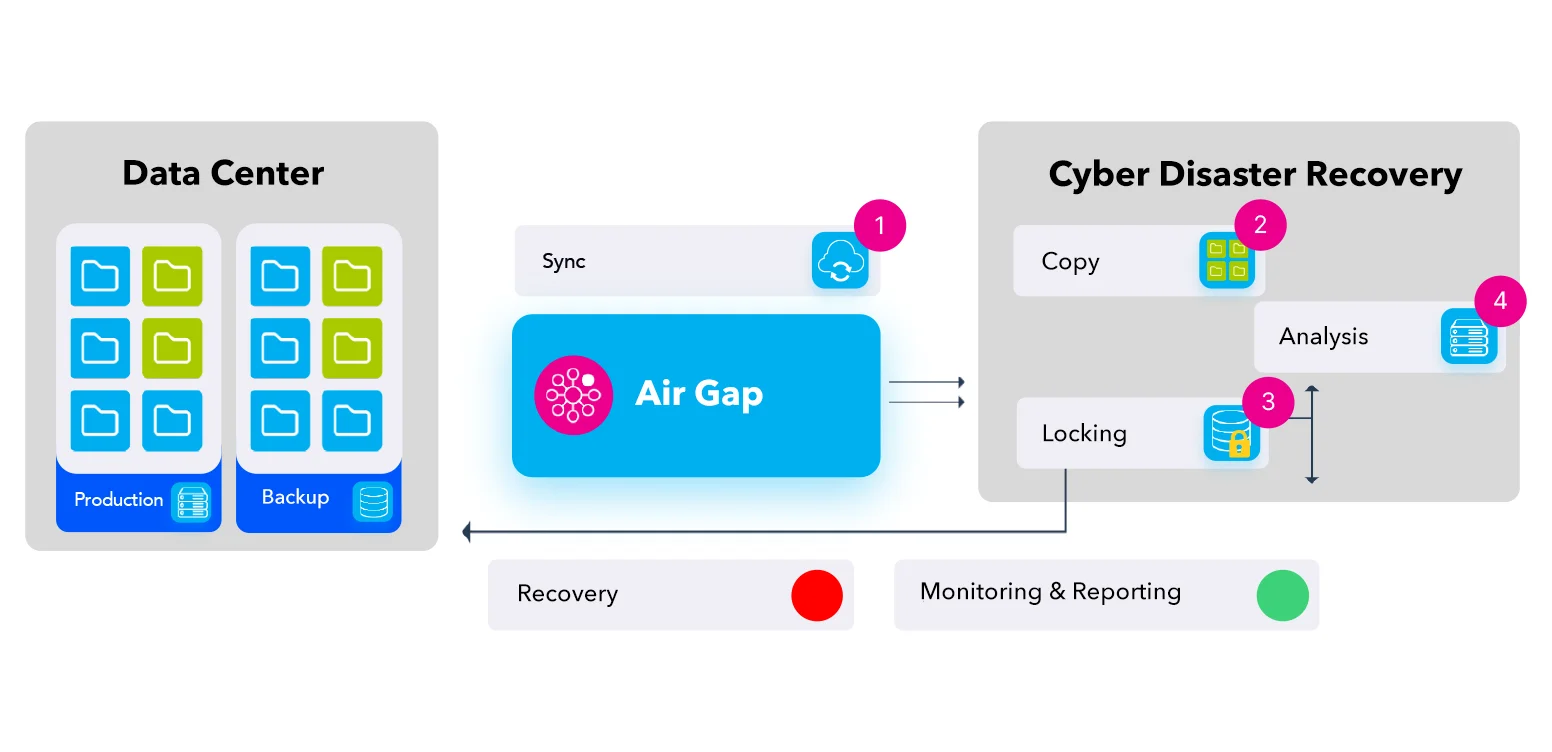
In today's business landscape, cyberattacks pose a constant threat to valuable data, potentially leading to financial losses and reputational damage. GlassHouse's PowerProtect Cyber Recovery Solution offers a state-of-the-art and intelligent defense mechanism to mitigate these risks promptly and recover your data efficiently. The CRS establishes a secure recovery vault that isolates critical data from the attacked environment, safeguarded in a physically isolated section accessible only through multi-factor authentication. Moreover, an automated operational air gap ensures network isolation and disables compromised management interfaces.
PowerProtect CRS streamlines the synchronization between production systems and the vault, ensuring that copied data remains unalterable through key protection policies. In the event of a cyberattack, you can quickly identify and access clean data copies to restore critical systems and resume business operations. The CyberSense software employs Machine Learning to detect corrupted data infiltrated by ransomware attacks within the data center, achieving a 99.5% effectiveness rate by analyzing content-focused parameters. These operations are carried out within the secure environment of the air-gapped vault. The data recovery and remediation workflows guarantee the rapid and reliable restoration of business-critical systems with PowerProtect CRS. Businesses leveraging the Cyber Recovery Service benefit from automated recovery features executed directly within the isolated vault.
Following the setup of your Cyber Recovery infrastructure, we collaborate to identify and prioritize critical systems requiring protection. Through data analysis, technology assessment, and recovery requirement definition, we tailor solutions to your specific needs. Leveraging our extensive expertise and the Dell PowerProtect-based Cyber Recovery service, we empower you to swiftly identify solid data and restore it securely.
CONTACT FORM
Complete the form to get in touch with us! Let's build the infrastructure of success for your IT operations together.
FEATURES
Discover the features of our Cyber Recovery Service

Clean Data Copies Stored in an Air-Gapped, System-Isolated Environment and Made Immutable
AI and Machine Learning-Based Security Analytics
Rapid Restoration in Line with Recovery Time Objective (RTO) and Recovery Point Objective (RPO)
End-to-End Solution Planning, Design, and Operation
Flexibility and Scalability
ADVANTAGES
Unveil the benefits of our Cyber Recovery Service!

Protect your critical data at the highest level, securing it against cyberattacks.
Reduce the burden on IT staff and prevent insider threats with a fully managed service.
Quickly restart your workflow by accessing offline, air-gapped 'golden' copies.
Protect against the costs of attacks and potential data loss by maintaining an air-gapped, immutable copy.
Ensure business continuity by rapidly restoring affected systems and services.
REFERENCES
We are a member of the teams of Turkey's leading companies!









Blog content that may be of interest to you

What is a Zero-Day? Zero-Day Vulnerability, Exploit, and Attack
Zero-day attacks are high-risk cyber threats that occur through the exploitation of security vulnerabilities that have not yet been noticed or patched by the software vendor, making them difficult to detect. In this content, you can learn the technical differences between a zero-day vulnerability, exploit, and attack, and analyze why these threats can bypass traditional signature-based security solutions. Additionally, detailed information on the key characteristics of zero-day attacks, prevention methods, and why disaster recovery services play a critical role in this process is available here. Start reading now!
Read More
What is a Pentest (Penetration Test)? Penetration Test Steps
In this content, the concept of pentest (penetration testing), the purposes for which it is applied, and why it is important for organizations are discussed. Throughout the article, you can see pentest techniques such as Black Box, White Box, and Grey Box methods, as well as different pentest types.
Read More
What is FortiAnalyzer, What Does It Do?
This article answers the question: "What is FortiAnalyzer?"—a solution offering powerful visibility for organizations seeking to retrospectively examine network traffic, analyze security events in detail, and detect potential threats at an earlier stage. Start reading now for the details!
Read More
What Is WPS (Wi-Fi Protected Setup)?
WPS (Wi-Fi Protected Setup) is a setup method that simplifies the process of adding devices to a Wi-Fi network. It can be enabled quickly via the WPS button on the modem or through software, and it is especially practical when setting up devices such as printers, smart TVs, and IoT devices. More details about using WPS are in this article!
Read More
What Is Fortinet FortiGate Firewall and What Does It Do?
FortiGate Firewall is a next-generation network security solution developed by Fortinet that protects organizations against cyber threats by inspecting network traffic in real time. It consolidates features such as firewall, antivirus, IPS, web filtering, and application control into a single platform. With its high performance and scalable architecture, FortiGate Firewall adapts to a wide range of requirements, from SMBs to large enterprises. Discover all the details about FortiGate Firewall in this article!
Read More
What Is FortiClient?
FortiClient is a comprehensive security software solution that protects enterprise endpoint devices against malware, phishing attempts, and network-based threats. By combining VPN, antivirus, web filtering, and compliance controls into a single platform, it enhances both security and secure employee access. For more details on FortiClient, a Fortinet product, keep reading our article!
Read More
What Is Phishing? Key Facts You Need to Know for Data Security
Phishing, or phishing attacks, is one of the most common cyber threats targeting the personal data of internet users. Typically carried out via fraudulent emails, SMS messages, or links, these attacks trick users into revealing critical information such as banking details, passwords, or account credentials. In this article, you can comprehensively learn what phishing is, how it is carried out, the most common techniques used by attackers, and how you can effectively protect against these threats with cloud-based security solutions.
Read More
What Is XSS? Cross-Site Scripting Vulnerability
XSS, one of the most common security issues in web applications, is a vulnerability that poses serious risks for both users and businesses. This flaw occurs when user-supplied data is reflected in the output without proper validation or encoding, allowing attackers to execute malicious code in the browser and gain access to sensitive information. In this comprehensive guide, you can explore what XSS is, how it works, which types exist, and how these attacks impact businesses in detail.
Read More
What Is a Network Security Key and What Is a Switch?
In this article, we have comprehensively explored what a switch — the device that manages data transmission between devices on a network — and Wi-Fi passwords known as network security keys are, where they are used, how they work, and how they can be found on computers and mobile devices. We have also gathered step-by-step password change instructions to resolve potential mismatch issues, key security considerations, and answers to frequently asked questions. This content serves as a comprehensive guide for users who want to manage their network infrastructure securely and efficiently. Offering both fundamental knowledge and practical solutions, it brings together all essential information needed for network security. Start reading now!
Read More
What is Nmap (Network Mapper)?
Nmap is a powerful tool used for network discovery and security auditing. It identifies devices, open ports, and running services on a network, providing administrators and security professionals with detailed insights. It offers an ideal solution for network management and security analysis in both small and large-scale environments. Discover more about Nmap, short for Network Mapper, right here!
Read More
What Are DoS and DDoS? Protection Methods in Cloud Environments
DoS and DDoS attacks are among the most common cyberattack types that threaten the continuity of digital services in organizations. In this article, we explain the differences between these two types of attacks and share effective methods to protect your cloud environments.
Read More
What Is a Hacker? The Importance of Hackers in Corporate Data Security
The concept of a hacker is one of the most critical topics in digital security, encompassing not only malicious individuals but also ethical professionals who work to protect systems. Those identified as hackers can be involved not only in cyberattacks but also in processes such as testing and repairing system vulnerabilities. In this article, you’ll find answers to questions like what a hacker is, how they operate, and the different types (white-hat, black-hat, and gray-hat hackers). You’ll also learn about the threats hackers pose to corporate data security — from data theft to infrastructure sabotage — and the technical countermeasures organizations can take.
Read More
What is a Port? Essential Information for Network Security
Ports are numerical addressing endpoints used to identify incoming or outgoing network traffic for a specific application or service on a device. They are the building blocks of data communication between computers and network devices, and each port type has a specific function. Understanding and managing ports correctly is essential for creating a secure and efficient network environment. In this article, you can learn the answers to questions like what a port means and discover the differences between TCP and UDP protocols.
Read More
How to Protect Your Business Against Cyber Attacks
While advancements in technology and digitalization bring great convenience, they also increase the threat of cyber-attacks. In particular, if businesses do not implement necessary security measures, cyber attacks can put data and business operations at serious risk. So, is it possible to prevent these threats? Absolutely. In this article, we explore methods businesses can use to protect themselves against cyber-attacks. Let’s dive into the details together.
Read More
What Is Spyware?
Malicious spyware that runs on a device without the user’s consent and transmits personal information to third parties can appear on both computers and mobile devices. These malicious programs can easily capture data such as keystrokes, social media accounts, and financial information. Their symptoms manifest as device slowdowns, unknown applications, and unexpected internet traffic. Examples of spyware include keylogger, Trojan, spyware, adware, and rootkit types. Regular scans and cloud-based security measures play a critical role in preventing these threats. Here is our article compiling all the details!
Read More
What Is Malware? What Are Its Types?
Malware refers to malicious software designed to damage computer and network systems, steal data, or leave the user without control. Explore malware types and tips to protect against them!
Read More
What Is a VPN? How to Set Up a VPN
Everything you need to know about VPNs—how they ensure secure internet connections and protect critical data—is in this post!
Read More
What Is a SOC (Security Operations Center) and How Does It Work?
This article covers everything you need to know about SOC, a centralized facility that monitors, detects, analyzes, and responds to cyber threats targeting an organization's information systems.
Read More
What is Identity and Access Management (IAM)?
In this article, you’ll learn about the concept of Identity and Access Management (IAM), its core features such as authentication, authorization, and user lifecycle management, how it works, key use cases, and the differences between IAM and CIAM. We also explore the importance of IAM and Privileged Access Management (PAM) in cloud security solutions, including their integration with services such as Firewall, WAF, IPS, Antivirus, and Vulnerability Management. Discover the vital role IAM plays in enterprise security operations!
Read More
Antivirus Security: Everything You Want to Know About Antivirus Software
Traditional antivirus solutions are mostly device-based and only protect the computers on which they are installed. However, today’s growing variety of cyber threats, remote work models, and large-scale networks make cloud-based security solutions almost a necessity for businesses. Curious about cloud-based Antivirus as a Service? All your questions are answered in this blog post!
Read More
What Is a Web Application Firewall - WAF? Types and Features
We’ve answered many frequently asked questions about one of the cornerstones of application security—Web Application Firewall (WAF). WAF is not just a security tool; it’s essential for business continuity and customer trust. Start reading now to learn more about Web Application Firewall and why it’s indispensable.
Read More
Be Prepared for All Scenarios: Disaster Recovery and Cyber Recovery
In today's world, where all business processes are digitalized, it is crucial for IT infrastructures to operate without interruption. Considering the volume and importance of the data being processed, ensuring the continuous and secure operation of systems becomes a top priority. In the event of natural disasters, human errors, or cyber attacks, two different processes are carried out: disaster recovery and cyber recovery. Before diving into the differences and importance of disaster recovery and cyber recovery, let's briefly examine what these concepts represent.
Read More
Stay Secure with Managed Security Services
Every day, more valuable data is either moved to or directly generated in digital environments. This trend directly influences the number and severity of cyber attacks. IT systems are increasingly targeted by more complex methods, making cybersecurity solutions for IT infrastructures more critical than ever. Let's explore how security services contribute to protecting your services and applications from cyber attacks.
Read More
What Is Data Leakage? How to Prevent Data Breaches in Businesses
In this article, you’ll find detailed insights into the causes of data leaks, their impacts on businesses, and the most effective strategies to prevent them. From cybersecurity fundamentals to advanced protection solutions, a comprehensive guide awaits you!
Read More
Best Practices for Safeguarding Data Privacy in Enterprises
Here are the precautions businesses can take to protect data privacy and the tools that help enhance data security. Discover the steps you can take to safeguard your corporate data.
Read MoreFrequently Asked Questions
The CRS architecture is designed to operate in full alignment with Dell Data Domain’s DD Boost protocol and its advanced deduplication and security features. This ensures that all data is transmitted, stored, and optimized securely end-to-end. In line with security policies, performance requirements, and operational standards, only Data Domain infrastructure is deployed within the CRS scope.
It is not mandatory; however, for a fully comprehensive CRS architecture, we recommend deploying the components in separate cabinets.
As long as your license subscription remains active, you can access all updates. If you prefer to perform upgrades without internet connectivity, Dell Technologies provides a USB device through which package upgrades can be installed.
One of the core advantages of this solution is the CyberSense AI-driven analytics technology. To fully benefit from advanced cyber-resilience and AI-based anomaly detection (e.g., CyberSense), your DD appliance must be a supported and current model approved by the manufacturer.
DR solutions ensure business continuity by maintaining redundant copies of data in a secondary location. However, traditional DR architectures do not include advanced cyber-resilience mechanisms such as air-gap isolation or anomaly detection. As a result, in ransomware scenarios, the replicated backups may still be compromised.
CRS takes DR one step further. Backups are stored in an isolated Cyber Vault environment (air-gapped). CyberSense analyzes backup data for corruption, encryption attempts, or abnormal behavior. This ensures that only clean and verified datasets are restored.
In short: DR guarantees the presence of a backup; CRS guarantees the backup is clean and trustworthy. This approach prevents long periods of uncertainty during an attack and enables rapid restoration using data proven to be uncompromised.
CRS is fully compatible with all backup software within the Dell Technologies ecosystem (Avamar, PowerProtect Data Manager, NetWorker, etc.). It also supports widely used enterprise backup solutions such as Commvault and Veritas NetBackup.
We provide Runbook documentation in both Turkish and English. Likewise, High Level Design (HLD) and Low Level Design (LLD) documents are also delivered in both languages.
CRS supports only backups taken on Dell Technologies PowerProtect Data Domain within its protection layer. When Oracle databases are protected via Data Domain AppDirect integration or Dell backup software such as Avamar / NetWorker, CyberSense analysis is applied. This analysis identifies suspicious changes, user/password modifications, anomaly behavior, or potential corruption, and alerts are generated automatically.
No. Even if you already have a Data Domain system, adding another unit is not sufficient to deploy CRS. The Cyber Recovery architecture also requires additional servers for hosting the Cyber Recovery Application, CyberSense, and management components, as well as the creation of an isolated and secure Cyber Vault environment.
Yes. CyberSense licensing is based on the raw data capacity, not on post-deduplication or post-compression size. For example, even if 100 TB of data is reduced to 20 TB on Data Domain, the license calculation is still based on 100 TB.
Yes, a firewall can be used instead of a Data Diode; however, there are architectural differences.
A Data Diode provides strictly one-way communication (from internal to external), minimizing the attack surface of the Cyber Recovery environment and allowing only SNMP, email, or Syslog alerts.
A firewall manages bidirectional traffic; if not configured properly, the exposure surface increases significantly. Therefore, very strict access controls are essential in firewall-based scenarios.
A separate NTP device is not mandatory. A local NTP configuration can be used within the Cyber Recovery environment. However, some organizations choose specialized solutions such as satellite-based NTP appliances for high-accuracy, independent time synchronization.
Yes. There is an interface/admin panel that displays license consumption and remaining capacity. In the latest versions, capacity usage is presented visually, making license tracking and capacity planning significantly easier.
Yes, we provide this service for customers operating on GlassHouse Cloud. However, the servers must also run in GH Cloud. While it is technically possible to deploy the architecture in public clouds such as AWS or Azure, it is not recommended. Key challenges include:
High network bandwidth requirements for replication, increasing cost
Significant disk, RAM, and CPU consumption due to indexing and analytics processes
More complex access control when applying air-gap principles
For these reasons, the most effective and cost-efficient deployment model for cloud-hosted CRS is on GlassHouse Cloud.